Monday, June 13, 2011

Avoid These!


Summer weekends, holidays, gathering of friends, travel… Sounds like an upcoming event? You bet! It’s the Father’s Day Bluegrass Music Festival at Grass Valley California! And, as far as I’m concerned, one of the top items, the important category to plan for, is the FOOD you will be enjoying while you’re there. (I’m rubbing my hands together just thinking about it!)
You’ll be bringing out all your diet-cheaters for this week. (Don’t lie!) Chips and dip. Thick marbled steaks for the barby. Homemade ice cream (You know who you are!). Salami, cookies, and all your favorite booze. And then, for your “cooking” day off, you’ll tour the strip and pick up a caramel mocha, Lazy Dog ice cream, and a big paper plate of biscuits and gravy. Yum!
But do consider, there is a dark side to some foods that make them either inappropriate or contraindicated for festival feasting. And that is where I, Dear Reader, hope to share with you from some of my experiences.

Foods to avoid at the Father’s Day Festival:

1. Oh, this one will be hard, I know. But really folks, try to avoid roasted garlic heads. Roasted or barbequed garlic heads are among my family’s favorite appetizers. You take a head of garlic, rub off some of the paper, slice off the top half-inch, drizzle olive oil, sprinkle with kosher salt and either bake in a garlic roasting dish or throw on the slow side of the barbeque. When they are done, the tender little cloves are slightly caramelized and will pop right out of their paper wrappings. You can spread them like butter on toast or crackers, or you can just eat them plain. Wow! Food ecstasy. But it comes with a price. And as soon as the essential aromas hit your bloodstream, you’ll know it. And everyone around you will too. And everyone who follows you into the necessary room will too--for 24 hours. So all of your friends, at least the ones who didn’t share your garlics out of self-defense, will probably try to avoid the garlic bubble you have created around yourself. And that’s not fun, at a Bluegrass Music Festival. (Unless, of course, you are willing to put up with that in exchange for plenty of elbow room in the audience area.)

2. Candy. Oh, not ALL candy, just those little candies that come, each and every one of them, in their own special individual crackly paper, cellophane and foil wrappings. When my kids were young, Halloween was always a cause of despair for me. All four of them would fill their paper lunch bags with individually wrapped Halloween candy and then stash them. For about 5 days following, I was constantly picking up the papers, nagging and threatening. Finally, I got smart. I said, “For each candy paper I find not in the trash, I get to pick one candy from each of your bags.” Try it Parents; it works.
At a festival, I really enjoy a clean campsite. There is nothing that will destroy that quicker that a carpet of fluttering multicolor candy wrappers. Get a big bag of M&Ms or Skittles instead.

3. This tip is for Fair Food Row. You like deep fry? C’mon! You know you do, yeah! Those funnel cakes? Yesss! You knew that was what I was talking about. Well, do yourself a favor and buy the one funnel cake you have allotted yourself on the first day of the festival while the grease is fresh. I’ve had one on both ends, and believe me, the one on the front end is better.

4. I hesitate to mention this one, because you’ll bring it; everyone does. But there is a hazard to cooking it. The food is bacon, and the hazard is that everyone within smelling distance will show up. You can’t disguise that smoky, porky aroma. So if you do risk bringing some, just make sure you bring more.

So load up your ice chests with a few healthful vegetables (pre-washed) to ease the guilt and lots of your favorite foods and treats, put some cash in your pocket for a teriyaki plate and a cold one at Verne’s and you’ll have a great time!

Monday, June 6, 2011

ECO; aka "Edible Cake-like Object


I made an ECO for my daughter's birthday cake.


We've been trying a new way of eating around here. From what I understand it is some kind of Paleolithic-Primitive-Primal-Carnivore diet. In other words, no grains. Vegetables, yes. Grains, those things that man has modified from the wild seed, cultivated, harvested, threshed and ground to flour are out. This is sort of an experiment. We are seeing what it does for weight, health, and, ahem, bodily functions.


For a disclaimer, I have no qualms about doing up cakes and pies and breads and stuff for other people. In fact, I just made 2 graduation cakes for my kids' graduation party. And I even had a small piece. Yum!


But for Bethany's birthday cake (today) I was just feeling really creative. And she is not all that fond of regular cake anyway. So I decided to create an edible cake-like object for her special cake.


I decided to start with a cheese ball recipe. If there is one thing we are all mad about in this house, it's cheese. I tweaked it a bit and came up with these ingredients: shredded 3-cheese blend, shredded medium cheddar, low-fat cream cheese (neufchatel), bacon bits, green onion, garlic powder, mayonaise and dried onion flakes.


I lined a round dish with plastic wrap and pressed the cheese mixture into it, refrigerating it overnight. About an hour before serving, I turned it out onto a cake plate. I frosted it with more cream cheese and decorated it with... OK, I hate to admit that I actually bought some of this stuff. It is seductive and cute and tasty. It's... EASY CHEESE! It comes out of a spray can, like whipped cream, and the tip makes the product cute and curly. And we had the choice of two colors: Orange, and Bright Orange.


It was great fun. I had to resist the urge to hold it up, aim it at my mouth and let go at the trigger. At first we made fun of it, but we all had more respect for the stuff when Loreleigh read the ingredient list, and the first one listed was "cheddar cheese."


I made a little pastry bag and squirted some Easy Cheese into it so I could write the words with a fine line. Then, with a dash of inspiration, I accented the ECO with dried tomato "flowers" and fresh rosemary.


We served the ECO in thin wedges with Pink Lady apple slices and hot tea. A good time was had by all.


Tuesday, May 10, 2011

Under the Pressure Cooker


About a week ago I bought my first pressure cooker.

I remember my mom using one every now and then. I didn't know enough to be scared of them back then, but as I began to realize how they worked, I was able to imagine the intense atmospheric pressure building inside a metal pot and how it could go off like a bomb, scattering shrapnel every which way, after it first took off your head.

Since their main advantage is that they cook things fast, I figured I had enough time to be safe and cook things slow.

But I am the curious sort when it comes to cooking tools and gadgets. So when I saw this 6 liter T Fal pressure cooker in great shape at the thrift store, I thought I'd give it a whirl.

The first thing I had to do was to figure out how to use it. God Bless the Internet! I found 2 important, nay, essential items there. One was the complete owners manual with 8 recipes. The other thing I found out from Miss Vickie's official pressure cooking site was that T Fal cookers are considered "overpriced and under-pressured." The overpriced part I didn't worry about, since mine was definitely not overpriced (about $10), but the under-pressured part meant that I wouldn't be able to use regular pressure cooker recipes without a little time conversion on my part. T Fal operates at 13 psi, while the standard is 15 psi. I finally found the fine print on that, which was to add about 20 percent more cooking time.

Since I sort of figured my main goal was to see if I would even like to own one of these things, I could put up with the lower pressure while I checked out the process. And there is also that secret satisfaction you get when you land an "overpriced" item on the cheap!

Now, back to the recipes, those 8 recipes. T Fal is made in France or some European place where they don't use sensible measurements like cups and teaspoons and such. They use grams and liters and some strange thing called "dessertspoonfulls." Ok, I didn't flunk math, and I'm pretty good on common sense estimating, so I can get through that metric stuff. But you'd think more of the recipes would be practical and enticing. Here they are:

Vegetable Soup: 4 potatoes, 2 leeks, 5 carrots, 2 turnips, 1.5 l (2 1/2 pt) of water, salt and pepper, 3 dessertspoonfuls of fresh cream (optional).

Basically, you cut them up, put them in the pot, pressure cook it, then stir in the cream. But really, turnips and leeks? Actually, I like leeks, but in America, you'd expect to pull an onion out and use it.

Citrus Cod Parcels: 4 cod fillet steaks each weighing 150 g, 1 grapefruit, 1 orange, the juice of 1 lime, 2 tomatoes, 1 onion, 2 chopped shallots, 60 g (2 oz) butter, 1 glass of dry white wine
(125 ml/4 1/2 fl oz), a few leaves of fresh tarragon, salt and pepper.

Here, they want you to use 4 sheets of aluminum foil to make 4 packets of these ingredients and then cook them in the optional steamer basket. (which I don't have) And aren't shallots basically another type of onion?

Roast Pork: 1 kg (2 1/4 lb) of boned pork rib roast or loin (keep the bones), 2 carrots cut into thick slices, 3 cloves of garlic, 2 onions (chopped), 1 sprig of thyme and 1 bayleaf, 3 tablespoon oil, 2 glasses of white wine (250 ml/9 fl oz), 1 dessertspoonful of sugar,salt and pepper.

I do like the frequent references to white wine, but there is a confusing part here. In the directions, they have you "Brown the roast and the crushed bones in the oil in the pressure cooker." Crushed bones? Do I take a meat mallet and crush them myself? Do I wrap them in brown paper and put them behind my rear tire and run over them a couple times? (remind me to explain how I dispatched a crippled baby rabbit sometime).

Chef's special boiled beef and vegetables: 1.2 kg of beef (silverside or brisket), 800 g (1 3/4 lb) of old potatoes, 1/2 a lemon, 1 onion spiked with 3 cloves,3 carrots, 3 leeks, 3 turnips, 1 stick of celery, 1/2 a celeriac, 1 clove of garlic, 1 bunch of fresh mixed herbs, 4 dessertspoonfuls of Port gherkins, cooking salt, salt and pepper.

First off, Americans do not refer to "boiled beef" in a menu selection. It sounds bland, tough, and entirely too British. But, it is the "Chef's Special," so it might be appetizing.

And next, what the heck is a "silverside?" Obviously something that European cows have evolved separately.

"Old potatoes." Too late; I threw them out. They were starting to leak and stink.

Leeks and turnips again, but this time we'll add something called celeriac, which I don't even know how to pronounce. But I think I've seen it in the produce section. Or was that a fennel bulb?

And now the biggest mystery: Port Gherkins. I know what Port is. I know what Gherkins are, little dill pickles. So I'd guess that means pickles brined with Port. But how do you get a desserspoonfull of them?

Ratatouille: 5 courgettes cut into slices, 4 aubergines cut into cubes, 4 large tomatoes (peeled and
cut into segments), 2 diced red peppers, 1 green pepper cut into strips, 2 large chopped onions, 3 cloves of garlic peeled and crushed, 1 sprig of fresh thyme, 1 bay leaf,1 sprig of rosemary, 1 small bunch of fresh basil, 1/2 a bundle of fresh coriander, 6 dessertspoonfuls of olive oil, salt and pepper.

Thanks to the movie, we all know how to say "Ratatouille," even if we still don't know how to spell it.

OK, I know what aubergines are, but what the heck are courgettes? For this, I have to go to wikipedia, and I find out they are... zucchini! Although I enjoy the word zucchini, I think courgette has a ring to it and I may adopt it for awhile and see who I can impress.

Caramelised three apple compote: 4 Braeburn apples, 4 Granny Smith apples, 4 Coxes Orange apples, 100 g (4 oz) of pine nuts, 60 g (2 oz) of butter, 100 g (4 oz) of brown sugar, 2 pinches of ground cinnamon, 1 teaspoon of vanilla essence, 1 pinch of ground ginger.

I have 2 questions here. What are Coxes Orange apples? Back to wikipedia, where I find, " Cox's Orange Pippin accounts for over 50% of the UK acreage of dessert apples."
Since there aren't any in America, we substitute with what we imagine them to taste like.
The other thing I worry about is that the directions explicitly say to use at least "250 ml (1/2 pint)" of liquid while pressure cooking. I don't see any water or other liquid in this one.

Mini Caramel custards: 250 ml (9 fl oz) of milk, 1/2 a vanilla pod cut in two, 3 egg yolks, 100 g (4 oz) of caster sugar, a few drops of vinegar.

I find out that caster sugar is what we call "superfine sugar."

Basque chicken: 1 whole chicken weighing 1.5 kg (3 1/4 lb), cut into pieces by your butcher or
4 chicken portions, 1 x 400g tin of peeled whole tomatoes, 1 x 400g tin of red peppers, 1 x 400g tin of green peppers, 3 chopped cloves of garlic, 3 sliced onions, 1 bunch of fresh mixed herbs, 2 glasses of white wine (250 ml/9 fl oz), 4 dessertspoonfuls of olive oil, salt and pepper.

And another thing, sometimes I use a REALLY big spoon for dessert. Especially if it's a rootbeer float.

This one sort of offends me. Maybe European women don't cut up their own chickens, but they American girls cut up their own chickens, by golly!

More white wine. OK, maybe this one will work.

So, what did I choose to inaugurate my cooker with? White rice.

The Cooking Times list showed that it should take 7 minutes. I put it all together, sealed it up and turned on the heat. I had the uncomfortable feeling that I should have a riot shield up in front of my face and torso. But I needn't have worried. I had done something wrong with the gasket and steam didn't come out the hole it was supposed to; it came out everywhere else.

I discovered that the gasket had crescents in it that had to match up with a pin. So I just salvaged the rice as well as I could.

quote at the table "Hey, this rice is nice and sticky, it is easy to eat with the chopsticks! Uh, is it supposed to be like this?"

Next try, the Three Apple caramel compote thingy. Same problem with the steam. This time I found out there is a small pin that has to go in a little hole in the gasket. Sheesh! Salvage the Three Apple Compote by stewing it.

But the next try was... SUCCESS! Yes, I cooked what could not possibly go wrong. I cooked some water. About a liter of the stuff. The little red pressure indicator popped up, although it was hard to see behind the cookie sheet I was using to shield my face and torso, the little steam dial gadget shot steam out like it was supposed to, and then I used to quick cool method of running cold water over the lid to get the pressure down and open the pot.

Voila! Hot cooked water!


Friday, May 6, 2011

When All Hell Breaks Loose


What will you do when all Hell breaks loose? Will you freak? Will you cry for your mommy? Will you follow the lemmings off the cliff? Or will you hunker down and eat whatever you have to, to survive?
I have a pretty strong survival instinct. I am good at imagining disastrous scenarios and the kits that should be prepared to experience them. I am also pretty good at improvising.

For example:
You have taken a drive out in the mountains. It's lovely, and you are thoroughly enjoying the scenery. Suddenly you realize how badly you want a cup of coffee! In fact, it becomes all you can think of, and you are even getting a little sleepy and wish you had the caffeine. No problem! Because you Are Prepared, you have stashed a few Starbucks Via packets in your console kit. Of course you have 4 stainless steel bottles of water in the back seat because you never go anywhere without a day's supply. You have a couple Sierra Cups also tucked away under the seat. Oops! No heat. No problem! Because you are also prepared to fight germs, you have a bottle of Purell in the console. You squirt a pile of Purell in one cup and light it off (you DO have matches or a lighter, right?), make up your coffee in the the other cup, and then you hold your coffee cup above the blue flame until it's hot enough.

Well, if you are the type of person who really can imagine this happening, then have I got a book for you. When All Hell Breaks Loose, by Cody Lundin.


It is totally packed full of the best ideas and practical solutions for surviving during a catastrophe. I love it how he doesn't squirm around and pretty up the words needed to get his advice across. He's not vulgar, just plain spoken in a way you can't misunderstand what he's talking about, from making emergency toilets to eating rodents. And that's where Food Adventures enters in!

Mice are Nice
(and here, I quote)
Mice can be put directly onto the coals of a fire whole... The heat from the coals will singe off the fur, but it will take some rubbing with a stick... to get off all the hair. Singed hair would make a T-bone taste awful so do a good job. If after the singeing process you think skinning is easier, be my guest. The skin will peel right off after precooking in the coals.

As the hair is being singed, the mouse will start to bloat up from the heat. Take this opportunity to scrape lightly at its abdominal cavity with something or gently tear it open with your fingers. At this time, most of the guts should begin to pop out of the opening you created. Near the end of the intestines, you will clearly see mouse t*rds headng toward the an*s. Get rid of all this stuff, but the heart, lungs, and almost everything else up near the head and middle of the body is good eating.

Once the mouse has been gutted and the hair singed, it's time to cook it on the coals. I like to cook them until they're between crispy and chewy, turning as necessary. Don't under cook them, but don't turn them into a piece of charcoal either form over cooking.


There are three bites to a mouse, the middle and rear being the best (in my opinion)... The head isn't bad, but eat it hot, as mouse brains suck when they're cold.

And I unquote.

If you read this book, you might be tempted to give up during the first 60 pages. That's where he's putting forth his philosophies on being prepared. Of course YOU don't need this; you already have that point of view, otherwise why would you be reading it? Just skim this part and you'll be rewarded with the rest of this fascinating and very practical book on being prepared for just about anything!

Tuesday, April 26, 2011

Pt. Reyes Backpacking, Pt.2


We took our morning coffee on the beach.

We watched the mouth of the stream collapsing the banks of sand that it had carved. I felt like I couldn’t take enough pictures to record the beauty that I saw.

After breakfasting on Grape-nuts mixed with trail mix and powdered milk watered up, we hit the trail. This was to be our first long day of hiking.

I couldn’t believe the wildflowers! I sketched many of them, took pictures of a few, and tried to memorize the rest. I had not spared the weight for any nature guides, but hoped to identify what I could. The best find I had was a low charming fuzzy little flower with a unique looking three petal arrangement. 'Elegant cat’s ears' was what I found out it was called. The lupine was everywhere. And ordinary mallow sported extra-lovely pink blooms.

We decided to take what beach access trails we had the time for and turned off down Sculptured Beach Trail. Not long into the decent, we met a couple with a dog who asked us breathlessly if we had a cell phone. Yes, but our phones had not had service since we arrived at Pt Reyes peninsula. A man had fallen from the cliff and was badly hurt down below! We agreed that they would continue up the trail to the ranger station and we would go down and see what help we could offer.

Erin had had rescue training, and besides that had the best bedside manner of the three of us, so she slipped down the little rock ledge to the crescent beach where he had drug himself the night before to gain shelter from the tides.

Melinda and I tossed down water bottles and food as she requested. We had some brownies left over from the night before, and she reported back that he said it “was like heaven” when she gave one to him. At first we were concerned about giving him food, but when we found out he was a trauma surgeon, we figured he knew what he was about.

When his buddies showed up, and when the rescue helicopters flew in, we knew our part was over, so we slipped away back up the trail.

We took the opportunity to check out other beach accesses along the trail, all of them lovely and satisfying, with waterfalls, cliffs, iron-stained rock, and crashing waves.

We were very excited to see our next campsite, Wildcat, laid out before us near the end of the day. We’d heard that our site, #7, was “The best one,” and I believe that was true. It was slightly protected from the sea breeze, close to the beach trail, and felt private.

The wild mustard was blooming insanely over the whole camp area. When I think back to the camp, all I can see in my mind’s eye is yellow, radioactive yellow.

We set up our tents and checked out the beach trail.

Part of the trail was covered in a trickling stream. I took a big deep step in a sticky mud bog walking down. But that wasn’t too bad because after that, I didn’t have to be careful anymore!

We took our dinner, which was chicken tortilla soup, down to the beach to eat. Thankfully, the wind was nothing like it had been the evening before.

We sat in the sand and sipped our steaming hot soup, drinking in the sunset over the water.

More hot cocoa and good conversation back at the camp and then off to bed. Again, I stayed warm!

Though I’m sure the Nalgene bottle of hot water in my sleeping bag didn’t hurt.

We took our morning coffee down at the beach again, admiring the waves, trying to decide if the tide was coming in our going out.

This day of hiking took us through some very interesting territory. At some points I felt like I was in a rain forest jungle. Then, all of a sudden, we entered a dark, sunless, pine tree shaded cave-like trail section.

Some sections took us along the precarious cliff overlook, some took us inland through the shrubs and wildflowers. And everywhere, there was poison oak, newly green and shiny red. The whole shape of Drake’s Bay was laid out before us as we stood at the cliff’s edge. I could see the Farallon Islands at the sea’s horizon.

We were nearing Palomarin Trailhead, the end of our trail the last section took us through eucalyptus groves, and I thought about what had brought these Australian trees halfway across the world to the California Coastline so many years before. I could smell the fragrant eucalyptus aroma as my feet crushed the pods scattered over the trail.

And then, all of a sudden, we came to the staircase and the end of our trail.

We shrugged off our packs and fell into the seat of Melinda’s truck, digging out ibuprofen to stave off muscle soreness later on.

We drove back to the hostel to my truck and divided up our stuff. Erin and Melinda took off for home, but I still felt like exploring. I drove on down Limantour Road to see what Limantour Beach was like.

Limantour Beach was only a mile or so away. Parking was available for horse trailers, so I knew it was probably a nice beach to take a horse ride, if a person had the patience to work their way across the peninsula to get to that point! The place was practically deserted, probably because it was 4pm on a Monday.

Crossing the marsh in front of the beach was easy and scenic with the nice bridge.

I loved the feeling of being on such a wide and long sandy beach, deserted, alone. The waves were quite high, the breeze was lightly blowing. The sun was coming across at a late spring afternoon angle, blue and clear, with only a slightly hazy horizon. Up the beach, to the north, I walked and walked. I would have walked as long as there was sand to walk on, but my practical nature took over and I made plans to turn around and walk back. Right then, I saw a post, solid set, alone right there on the beach. I set my camera on it, put it on automatic, and took a picture of myself.

What is it about the sea that is so glorious?

Now it was time to go home, so I waded through the sand of the beach trail, back to the parking lot and into Truckita, dialing up “Home” on Kathleen (GPS). Now that I had missed the major commuter hours, my trip home was pleasant and uneventful. A nice time to go over in my mind our trip, and to think about the next one!

Monday, April 25, 2011

Pt. Reyes Backpacking, Pt. 1


I’d been looking forward to this backpacking trip for a long time. Perhaps too long. Sometimes I think it would be better to wake up in the morning and have someone tell me, “Hey! Tomorrow morning we head off on a 3 day backpacking trip. Get ready!” Then I kick into high gear and tear around like crazy putting it all together, and then we leave.

But instead, what happens is this: I putter around for weeks, months even getting every little thing ready, getting more anxious as the time approaches, anxious that I might have forgotten something to put on my list that I can’t actually pack until closer to the last minute. But will it all fit? And what will it weigh? So several trial pack-outs ensue. And then FINALLY it’s for real.

Saturday April 9, I drove out of Marysville at 6:30 am, headed for the Bay Area. Lovely drive, NO TRAFFIC! A lovely byproduct of a Saturday morning. Pt Reyes is a really confusing area when trying to figure out a route with all the roads winding around there. I never realized that it even existed before, this whole peninsula full of beaches and trails and wildlife. I set Kathleen (my GPS) to take me to Bolinas, since she didn’t seem to recognize any of the other locations I typed in. From Bolinas I could follow the written directions.

Highway 1 is the most incredible stretch of road! I traveled a piece of that working my way northwest to my destination. I had been on it about 40 minutes traveling north, when all of a sudden I had the awful thought that I should have been traveling south on it! I got all shaky and pulled over as soon as there was a wide spot and pulled out my map, disoriented as to where I even was. I was going the right direction, and almost to Bolinas, so I got on my way again. But it took about a half hour to lose the quiver in my gut!

We were to meet at the Palomarin trailhead at 10am. I arrived at 9:50am. Melinda and Erin showed up a few minutes after 10. This kind of timing was pretty amazing, since neither of us had been over there before and were giving it our best guess for driving time! We left Melinda’s truck parked there and piled into my truck for the long haul to the Bear Valley Visitor Center to take care of the paperwork. There are some nice picnic areas and a wildlife interpretive center there. At the little store, you can buy any kind of nature guide you can think of.

From the visitor center, we then drove over to The Hostel, which is about a mile inland from Limantour Beach. That is where the Coast Trail begins at the Laguna trailhead. We ate our lunches and then got our packs ready to go. Even with my new pack, Melinda found a lot of humor at my expense concerning the gear I had lashed and dangling on the back. Old habits die hard! My pack weighed too much, I’m sure. It was about 34 pounds without water. Yikes!

Only a short distance into the hike, we had our first obstacle. A lake of water across the trail. There was a scrubby little trail that crawled up the hill beside the trail, obviously someone looking for a path around. But did they make it all the way up, around and down? Erin and I gladly sent Melinda to do that while we discussed how we were going to wade it. Melinda kept calling out encouraging words like, “I don’t think you guys can do this,” while we rolled up our pants, and took off our hiking boots and slipped on our sandals and crocs. It never got up past the calves, thank goodness! We met up again and went on our merry way.

This first day we only had a couple miles scheduled for hiking. We had so much driving and staging, and then shaking down the pack-out that it seemed for the best. Those miles were fairly level and pleasant as we approached the ocean and our first camp.

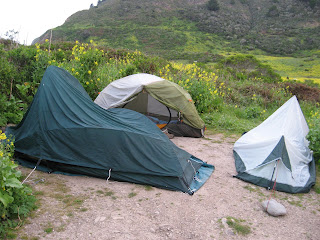
Coast Camp is at a small grassy valley a short distance away from the beach. A drinking water tap and clean vault toilets are at the main camp area, and around the bend seven campsites are tucked along a short trail. Each of these campsites has fairly decent privacy, as opposed to the ones in the little valley. What looked like a Boy Scout troop was camped in the main area. It was sweet to see them with all their little tents and such, but still, I was glad they were there, and we were over here!

The wind was really blowing, but we got our tents pitched and went down to see the beach. Every beach we went down to was just gorgeous. The waves were rolling, curling and breaking close to the sand, like it does on these steeper-sloped northern beaches. The wind was blowing sand grains against my ankles as Erin and I trudged south along the wet sand. We were headed downwind, and I knew that when we turned around to head back, we’d have to pay the piper and lean into the blowing wind. We came upon a swift-flowing stream that was cutting across the beach and into the ocean. It was rocky there and could have had interesting tide pools in it, but it didn’t look safe enough to go hopping around on it. Every time a particularly big wave crashed over the rocks, the gulls would hop up a few feet into the air, hovering until the wave washed back out again.

Each camp was supplied with a locking food box to keep the supplies out of the hands of raccoons and other critters. We had gotten a beach fire permit (driftwood being the allowable fuel), but it was so windy there was no question of us wanting to do that! The camps also had barbeque grills, if one was so inclined to pack in briquettes. Now when the rules were read to us, an emphasis was made on the fuel. Wood—beach. Briquettes—barbeques.

Close to sundown, a ranger came to check on permits, food box usage and… fires. We passed inspection. Meandering up the campground trail, we happened to view one of the campsites also under inspection by the ranger. He was lecturing a group on the use of the barbeques under the steaming veil of wet smoke that was emanating from the drenched log on the grill. I heard him say, “…next time I’ll issue a citation,” and it made me glad I hadn’t been tempted to throw a log on the BBQ and light it off!

We reconstituted the Burgundy Beef Stew I had made up and fixed up a couple packets of loaded mashed potatoes. We had brownies for dessert and hot cocoa on top of that. What was going through my head was that the more calories I could consume, the warmer I would stay during the night.

When I was younger I NEVER stayed warm enough when camping. No matter how many clothes I layer on, how thick a sleeping bag, I always had to worry about being cold. I don’t know if it was the calories or if it just wasn’t that cold, but I had a very comfortable night.


Saturday, April 23, 2011

What is the True Meaning of Peeps?


All around the world we human beings anticipate the approach of our traditional holidays. Families, friends and social and religious groups meet to celebrate the rituals and feasts and curious habits of each holiday. If you live in America, thanks to the retailers and advertisers, you can’t NOT know the trademarks of each major holiday, which are conveniently spaced throughout the year to provide maximum shelf time for all the props and edibles.

Pondering the commercialization of our American and Christian holidays, I’ve wondered about two things: One, why haven’t the retailers managed to insert a few clever holidays in some of the ‘blank’ months, like September? Two, will they ever manage to completely ruin Thanksgiving with chocolate turkeys and Thanksgiving trees?

If I were to answer my own questions, I guess I’d say that for the first, the retailers rely on ‘bleed-over,’ that is, sticking with what works best, which is Christmas. Why invent a new holiday when you can just bring Christmas a little closer? And handily enough, this also answers the second question. Leftover packages of turkey paper plates and pilgrim-themed centerpieces don’t bring in the bargain-hunters the day after the fact like day-old Christmas candy and decorations do!

One thing that fascinates me is the symbolism of certain foods that show up at all major holidays. There are shaped foods, which are cute, fun, and obvious as to their message, such as candy or cake hearts for the holiday of love, Valentine’s Day, cookies shaped like Shamrocks or four-leafed clovers for luck that abound on St. Patrick’s Day, and Candy Canes that are said to represent a shepherd’s crook for Christmas, bringing to mind the first visitors of the infant Jesus. And for the holiday upon us, Easter, nothing is more iconic than the chocolate Easter Bunny.

But I wanted to look just a little deeper at the symbolism of holiday food at this time of the year, and these are some of the things I have found out.

Easter Eggs. Love’em or hate’em, Easter Eggs are embedded in the holiday and will never be dislodged. Chocolate, marshmallow, decorated sugar, Whopper, jelly, hard-boiled or plastic with candy inside, there’s a kind for every taste. But why eggs?

Eggs are traditionally connected with rebirth, rejuvenation and immortality. This is why they are often associated with Easter. Eggs were colored, blessed, exchanged and eaten as part of the rites of spring long before Christian times. Ancient peoples thought of the sun's return from darkness as an annual miracle and regarded the egg as a natural wonder and a proof of the renewal of life. As Christianity spread, the egg was adopted as a symbol of Christ's Resurrection from the tomb. On a more practical level, in the early Christian calendar eggs were forbidden during Lent. This made them bountiful and exciting forty days later.

Breads. As bread is the staple in the diets of many cultures, it is also full of symbolism in religious ceremonies and holiday banquets. As Christ shared the bread with his disciples at the Last Supper before the crucifixion and resurrection, Christians repeat that ritual with a bit of unleavened bread as a remembrance.

In a pagan note, the word ‘Easter’ comes from the name for the Anglo-Saxon goddess of light and spring, Eostre, and special dishes were cooked in her honor so that the year would be endowed with fertility. Most important of these dishes was a small spiced bun. The Egyptians offered small round cakes to the goddess of the moon, each marked with a representation of the horns of an ox, which were her symbol. In ancient Greece, a similar small, sacred bread containing the finest sifted flour and honey, had the name bous meaning ‘ox’ and from which the word ‘bun’ is said to have originated. The Christianized form and the ritual of baking ‘hot cross buns’ became standard practice of the Easter celebration in English society. ‘One a penny, two a penny, hot cross buns.’

Meat. Probably the most symbolic main dish to grace the Easter or Passover table is lamb. According to the Encyclopedia of Religion, Mircea Eliade editor in chief [MacMillan:New York] 1987, volume 5 (p. 558):
‘Among Easter foods the most significant is the Easter lamb, which is in many places the main dish of the Easter Sunday meal. Corresponding to the Passover lamb and to Christ, the Lamb of God, this dish has become a central symbol of Easter. Also popular among European and Americans on Easter is ham, because the pig was considered a symbol of luck in pre-Christian Europe.’


I tend to think that ham is popular because it is easy to cook, everyone likes it, it is much cheaper than lamb, and all the stores carry it. Just try to find a leg of lamb at a Walmart SuperCenter!


I find the ritual and symbolic aspect of the Jewish Passover Seder most interesting. Some of the traditional foods are:
Matzoh (sort of a cracker): Three unleavened matzohs are placed within the folds of a napkin as a reminder of the haste with which the Israelites fled Egypt, leaving no time for dough to rise. Two are consumed during the service, and one (the Aftkomen), is spirited away and hidden during the ceremony to be later found as a prize.
Maror: bitter herbs, usually horseradish or romaine lettuce, used to symbolize the bitterness of slavery.
Charoses: a mixture of apples, nuts, wine, and cinnamon, as a reminder of the mortar used by the Jews in the construction of buildings as slaves.
Beitzah: a roasted egg, as a symbol of life and the perpetuation of existence. (Here’s that egg again!)
Karpas: a vegetable, preferably parsley or celery, representing hope and redemption; served with a bowl of salted water to represent the tears shed.
Zeroah: traditionally a piece of roasted lamb shankbone, symbolizing the paschal sacrificial offering
Wine: four glasses of wine are consumed during the service to represent the four-fold promise of redemption, with a special glass left for Elijah the prophet.
(http://homecooking.about.com/od/foodhistory/a/passoverfoods.htm)


I know that people today have their traditional family favorites they bring to the holiday table. And if you showed up without it, your relatives would scream, ‘What! You didn’t bring the Cranberry Walnut Jello Salad?’ But what would be fun and thought-provoking is if we could assign each part of these newer traditional foods special symbolism for the group that is partaking.


Now wouldn’t that be more meaningful than another Easter basket full of Peeps and jelly beans nestled on pink plastic Easter grass?


(BTW, what is the true meaning of Peeps?)